Browsing CategorySewing

Magnetic Thread Rack

I no longer have room for a  thread rack on the wall so when I sew, the spools sit on my sewing table, getting lost in the piles of fabric or waiting for some bored cat to come along and knock them off. I decided I needed to make a small thread rack that could be put away when not being used, so I made a magnetic thread rack.

Materials:

  • magnetic tray like a toaster oven pan or small baking pan. (I found mine at a dollar store.)
  • magnets
  • long screws with flat screw head
  • super glue
  • fabric to cover the tray

I used really small earth magnets because that’s what I had on hand. If I had to do it over, I’d use bigger earth magnets because these magnets aren’t strong enough to support really large spools of thread.

Create your thread rack pegs by super glue-ing the magnets to screw heads.

Cover the tray with fabric. I used hotglue to glue the fabric on.

Now you just put the screws with magnets on the tray so they can be used for thread spools.

I wanted to have the thread rack propped up, or hanging on the wall, so I swung by the framing section of JoAnn Fabrics and picked up a plate holder rack and a plate hanger.

A plate holder rack is like a small easel and is perfect for when I want the thread rack on the table within reach.

The plate hanger attaches to the back of the tray and is good for when I want the thread rack hanging on the wall.

Or in my case, when I want to hang the rack on the mirror behind my sewing table. I used a suction cup hook to hang up my magnetic tray.

One of my recent projects was making a bunch of sewing organizers that I assembly line produced, and I had to constantly swap threads spools and bobbins on 2 different sewing machines. The magnetic thread rack was super useful in helping me keep track of all my thread.

As an added bonus, it kept Bobo from chasing my thread spools right off the table which is one of his favorite activities.

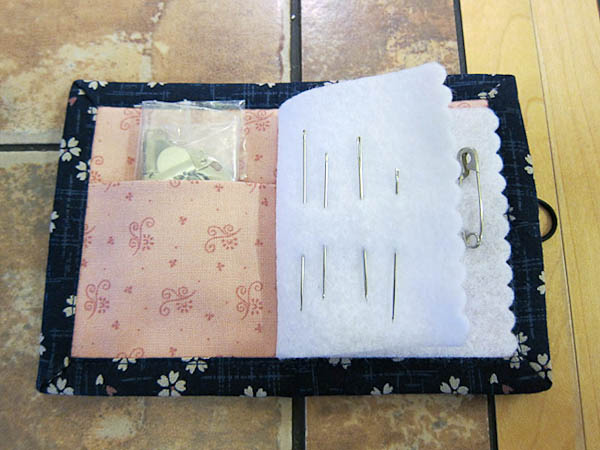
Small Needle Book

I’ve found a good way to store and transport needles is in a needle book! I love making these because they require very little fabric so are great projects for those pretty scraps you have sitting around.

Materials:

  • A.  5 1⁄4” x 3 1⁄2” of cover fabric
  • B.  5 1⁄4” x 3 1⁄2” of inside fabric
  • C.  5 1⁄4” x 4 1⁄2” of inside fabric for pocket
  • D.  1 1⁄2” x 20″ of bias tape fabric
  • E.  4 3⁄4” x 2 3⁄4” of felt for needle pages
  • F.  2 1⁄2” x 3 1⁄2” of peltex, cut 2 (can be found in the interfacing section of JoAnns)
  • G.  2 1⁄2” piece of elastic
  • button (not pictured)

To start, fold the pocket piece (C) in half and iron flat.

Place the cover fabric (A) face down.

Lay the inside fabric (B) on top.

Lay the pocket piece (C) on top. Line up all the bottom edges and pin the pieces together.

Lay the felt piece (E) on top, centering it and pin in place.

Now you need to mark the 2 stitching lines that will make up the spine of the book. From one edge of the book, measure 2 1⁄2” and draw a line.

Do the same from the other edge of the book.

Stitch along the 2 lines. Remember that the bobbin thread will show on the cover of your needle book so you might want to pick a color that matches.

If you have pinking shears or scalloped scissors, you can trim the edges of the felt pages with a decorative edging. If you don’t (or have no idea what pinking shears are), no worries, you can just ignore this step!

Now take one of the Peltex pieces (F) and slide it in between the cover (A) and inner fabric (B).

Pin the Peltex in place.

Repeat with the other piece of Peltex on the other side of the thread book.

Baste around the outside of book with as small of a seam allowance as possible.

Make a loop with the elastic (G) and sew it on to the back of the book. (I forgot to take a photo of this step when I was making the first needle book, so I took a photo on the second needle book, which is why the fabrics are different here.)

I didn’t think any of the standard bias tape sizes you can purchase worked for the needle book so I opted to make my own. You don’t need a lot of bias tape so it goes very quickly!

Take your bias tape fabric (D) and fold it in half lengthwise and iron.

Open up the fabric and then fold each side in to the center fold and iron.

Fold the bias tape fabric back up, iron it one more time, and you’ve created bias tape!

Take your bias tape and bind the edges of the book. I’m not going into the details of how to apply bias tape here as there are a lot of tutorials online on how to do it.

Random tip: if you have some stitch witchery handy, use that to hold your bias tape in place until you sew it all down. I find that helps me keep the bias binding on my craft projects very neat.

Another thing that I found helpful is pinning the needle book pages together and out of the way so they don’t get caught as you are stitching down the bias tape.

After you’re done binding the edges, sew a button onto the front. You can use a regular button or a decorative button. In one of the samples at the top of this post, I used a decorative cat button which I thought was appropriate for this blog!

And you’re done!

Sofa Caddy

So you’re sitting at your couch and your cat takes up residence in your lap and starts making kitty bread on you and you realize his claws are SHARP! You need a nail clipper stat but there is a fuzzy anchor in your lap and no nail clipper within reach…

Does this only happen to me?

While a sofa caddy doesn’t solve this problem 100% of the time, I figured it might help some of the time. I also needed to make some other things accessible while sitting at the couch so this was a good one day project for me.

You’ll need 2 fabrics: the pretty fabric that shows and the backing fabric. Try to pick something that won’t slide on your couch for the backing. For example, satin is very slippery and a bad choice. Flannel is a good choice for a microfiber couch which is what I went with.

Materials:

  • 1/2 yard of fabric
  • 1/2 yard of backing fabric
  • 1/2 yard of lightweight fusible interfacing
  • one package of double fold 1/2″ wide bias tape

Cut one of each of these rectangles from the fabric, backing fabric and interfacing:

  • 11″ x 30″ – sofa caddy base piece
  • 11″ x 10″ – large pocket
  • 7″ x 13″ – small pockets

Fuse the all the interfacing pieces to the back of the corresponding fabric piece.

Lay the sofa caddy base fabric on top of the backing fabric, wrong sides together.

Baste the 2 pieces together using a 1/4″ seam. Do the same for the 2 pockets: lay the fabric on top of the backing fabric and baste.

Using the bias tape, bind the top edge of both pockets.

On the small pockets piece, mark a vertical line 6 1/2″ from the edge

On the large pocket piece, mark a vertical line 5 1/2″ from the edge.

Lay the small pockets piece on top of the big pocket piece, lining up the vertical lines so that they are on top of each other. Pin the fabrics in place.

Stitch down the marked line, make sure to sew a bit past the bias tape.

Stitch a 2nd line 1/4″ away from the vertical line you just stitched.

Now take the small pocket piece and line up the edges so they match the larger pocket underneath. You’ll have to put a fold in the bottom of each small pocket . Pin everything in place.

Place the pockets on the base piece, lining them up with the bottom of the base and baste the pockets in place.

The last step is to bias tape around the edges.

Find a handy sofa arm to put the caddy on and tuck the end without pockets between the seat cushion and the arm and you’re good to go!

Cat Towel Holder

Our towels were forever falling off the oven handle so I decided to make some towel holders and of course, I had to do a cat themed one!

I got the idea for the applique from this adorable cat quilt I found on Pinterest.

This towel holder has a rod inside so that the towel can be swapped out. I didn’t want to make a towel holder that was permanently attached to the towel because I really did not want to have to make a towel holder for every single one of my kitchen towels. This seemed like a more efficient solution to my towel woes.

Materials:

  • 4 colors of felt – orange or brown for main color of cat, pink for ears, white for eyes, grey for the wall
  • 7″ plastic or wooden rod – I cut up a hanger to get my rods
  • 1 piece of 10″ x 7″ fabric for the front
  • 1 piece of fusible fleece about 11″ x 8″ (found in the interfacing section at Jo-Anns or you can use regular interfacing)
  • 1 piece of backing fabric about 11″ x 8″
  • 1 piece of 10″ x 2.5″ fabric to make loops for the rod – this won’t show so any fabric will do
  • 1 package of extra wide double fold bias tape
  • 2 large snaps
  • Black acrylic paint or black puffy paint
  • Fabric glue
  • Hotglue

You’ll need a 7″ rod to hang the towel on. I took a hacksaw to a plastic hanger to get my rods.

Now make a fabric sandwich with the backing fabric, the fusible fleece, and front fabric. Pin the layers together.

Quilt the fabric – that means stitch all the layers together. I chose to do a criss cross pattern for my towel holder.

I like the look of quilting but you can skip the quilting step and use interfacing instead. You just need to put something in the middle to give the towel holder a bit of stiffness.

Trim all the layers to match the top layer. You should end up with a 7″ x 10″ rectangle.

Cut out the cat applique shapes using the PDF pattern. You want to use the cat colored felt for all the pieces except for the inner ear pieces which are pink.

Cut a 1.5″ x 7″ strip of grey felt for the wall. Glue the wall down onto your quilted piece.

Glue the cat pieces down next.

You don’t have to do this step but I wanted to make sure the cat applique didn’t come off so I zigzagged around all the edges.

Now use the acrylic paint (or puffy paint pen) and draw a pair of eyes on the white felt.

Cut out eyes and glue them to the cat. Draw on the nose, mouth, and whiskers.

Finish the edges using the bias tape. I like to make my own bias tape but that’s usually because I’m too lazy to run to the store to buy bias tape that matches my project.

Now we need to make the loops to hold the towel rod. Take the 2.5″ x 10″ strip and fold it in half and iron.

Open the piece up and take each side and fold it to middle and iron.

Fold the entire piece back up along the center fold and iron one last time.

Stitch down both sides of the strip close to the edge.

Cut two 4″ pieces from the long strip you just created.

Sew the ends together to make a loop using a 1/4″ seam.

Flip loop inside out.

Stitch again with a 1/4″ seam allowance, going over the seam you just stitched. This traps the raw edges inside so they don’t fray.

Flip the towel holder over and on the side opposite of where the cat applique is, mark 2″ from the bottom edge.

Pin the loops at the mark and stitch them down.

Hotglue the rod to the loops.

You’re almost done! The last step is to sew on snaps. One side of the snaps should go above the towel rod loops, and the other side should be mirrored on the other side of the towel holder when you fold it in half.

Please ignore my mis-matching snaps. I was down to my last two and again with the “too lazy to go to the store”. I figured no one would see them anyways… well, no one except for anyone reading this tutorial…

And you’re done! You just need to put a towel on the rod…

And wrap towel holder around the oven handle and snap it in place.

You can use this technique to create towel holders from any fabric you have laying around. I also made a mouse one because my husband likes mice. (Oh the irony…)

And now you have cute towel holders for your kitchen!

Using Up Scrap Fabrics – Mission Report #1

It’s a never ending goal but I’m actually making some progress on my scrap fabric pile! My last few projects have been fast, fun, and easy, and if you’re looking to use up some of those cute remnants you have laying around, here are some good projects.

I’m completely in love with this lunch bag tutorial from Pink Penguin. I don’t think I’d use this as a lunch bag but it’s versatile enough to be used for anything and it’s a decent sized bag. I took a photo next to Yoyo for scale… he looks a little put out because I woke him up to take the photo.

My first bag was a bunny themed one that I sent to Aimee. Most of the fabrics in this bag were leftovers from the quilts I made for her daughters 2 years ago.