Magnetic Pin Cushion for a Dressform

I’ve discovered that one of my biggest pain points with historical costumes is trying to have my pins handy while I’m pinning on 12 yards of trim. I try to have my magnetic pin cushion near me while I’m working, usually resting on the edge of the couch, but then Bobo will come along and knock it off. (Yes, gravity still works Bobo… thanks for checking!)

I was joking to D that I needed to hang my magnetic pin cushion on my dressform somehow to make my life easier and her response was something along the lines of, “Well why don’t you?”

… Right!

So today’s post is possibly useful to no one but me, but now I’m excited to try out my new dressform magnetic pin cushion on my next outfit!

I purchased some super strong magnets from Home Depot. (I love Home Depot in case it’s not obvious…)

I measured my dressform neck circumference and added 3″ for how long to make my pin cushion strap. My dressform neck is 13″, so I cut a strip 16″ long and 3.5″ wide out of some leftover quilting fabric.

dummy_pincushion-10

I folded the strip in half lengthwise and made a tube by sewing along the length of the strip using a 1/4″ seam allowance. Then I flipped the tube inside out and ironed it flat.

I folded the strip in half to find the center and marked a line 2 3/4″ from the center.

I stitched along the line, dropped the magnet into the tube, and then marked a vertical line on the other side of the magnet. I sewed along the new line, sealing the magnet in.

I closed the ends by folding the raw edges inside and stitching the tube closed on both sides.

I took my magnet necklace to my dressform and pinned it on and marked where the ends overlapped. I used a pin to mark where the overlap is, but you can also use chalk or a fabric pen.

Then I took the magnetic necklace off the dummy to sew a closure on. I prefer hooks and snaps over velcro because velcro can tear up fragile materials that I might be draping, but whatever you have on hand will work. I went with a huge snap because I have a ton of these.

And here is the finished magnet pin cushion necklace!

Using Manila Envelopes for Pattern Storage

Once upon a time, I tried to store my used patterns back in the tiny envelope they came in. Talk about an exercise in futility. It was never a pretty scene trying to cram all that tissue paper back in. Then Judy showed me how she stores her patterns in manila envelopes. It was a life-changing moment and I never had pattern storage issues again.

I pull out the pattern pieces and instructions from the pattern envelope, and then I cut up the envelope.

I have a stack of 9″ x 12″ manila envelopes just for patterns. I tape the cut up pattern envelope to the outside of the manila envelope, and then I stick all the pattern pieces and instructions inside. And now, even after I’ve opened up the nicely folded tissue paper pattern and made a big mess of folding it back up, I will still have a nice roomy envelope to put everything back into.

The best part is that the manila envelopes can be stored in filing boxes. I got these boxes from Target and use filing folders to categorize my patterns so it’s easy to find what I need.

My house is really small so I have to put my pattern boxes in the garage. I might have a few too many patterns…

I’ve also seen people store patterns in large ziplock bags, so that’s another option if you don’t want to use manila envelopes.

Anyone else have any good pattern storage suggestions? I’d love to see/hear about them!

Interfacing Tissue Paper Patterns

If you have pattern you really like and will be using a lot, backing it with fusible interfacing is a good way to preserve the tissue paper. Interfacing isn’t cheap though so I only do this for patterns I know I will be using a lot.

(And if you own cats, this is also a good way to rescue pattern pieces they’ve turned into cat toys…)

So here is Yoyo demonstrating his amazing pattern destruction abilities…  Thanks Yoyo!

Rescue your pattern piece from your fuzzy monster and lay it out as flat as you can on your ironing board.

After assessing the damage, this pattern doesn’t look too bad actually. If the pattern just has some crumpling and tearing, we can save it. If it’s been completely destroyed (like your cat used it for a chew toy as well as a scratching toy), it’s probably time to start stalking Joanns for the next 99 cent pattern sale, and just replace the pattern.

Set your iron to the lowest setting and start ironing your pattern. You want to go gently and lift up your iron in places where there are tears so you don’t tear the pattern farther. If the iron isn’t hot enough to press your pattern flat, turn it up a little. You don’t want to get too hot though as that will cause the tissue paper to warp.

Now get a piece of interfacing big enough to fit your pattern piece.

I like to wait for interfacing to go on sale at Joanns for 50% and then buy an entire bolt of the lightweight fusible interfacing. Always having interfacing around is pretty handy.

Lay your interfacing on the ironing board so the fusible side is facing up. Lay your pattern piece on top.

Now grab a scrap piece of fabric to use as a press cloth. I used a scrap piece of muslin. Lay the press cloth on top of the pattern and fusible interfacing, making sure you cover the areas where the fusible surface is exposed. The press cloth is to protect your iron from getting fusible gunk on it as you iron. You’ll probably want to throw it out after you’re done as it will have sticky residue on it.

Start ironing your pattern. You might need to turn the iron a bit hotter to make sure the fusible melts and attaches to the pattern.

Iron down your entire pattern and when you’re done, trim around the pattern piece.

And now you have a sturdy interface-backed pattern piece that will last a very long time!

Photo Magnets

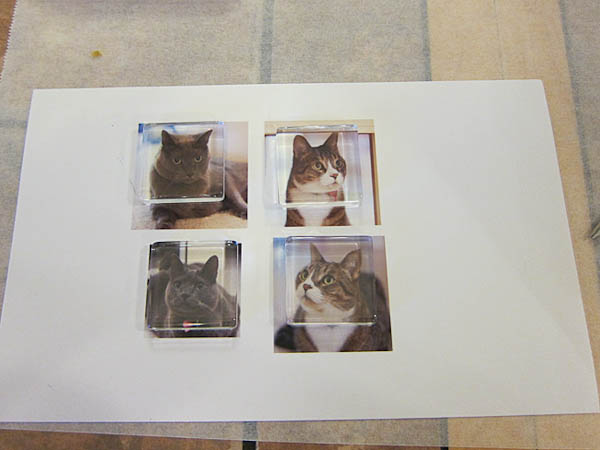
We needed some more fridge magnets and I thought it’d be fun to make some glass tile photo magnets of my fuzzy kids.

You can find a lot of tutorials for making glass tile magnets on Pinterest, and they’re all variations on the same theme. Here’s how I make photo magnets…

Materials:

First step is to print out photos that you want to use for your magnets and make sure they will fit in the tiles you have.

I’ve discovered that printing on regular paper or cardstock works better than printing on photo paper. Photo paper smears very easily and gets blurry when Diamond Glaze is applied to it.

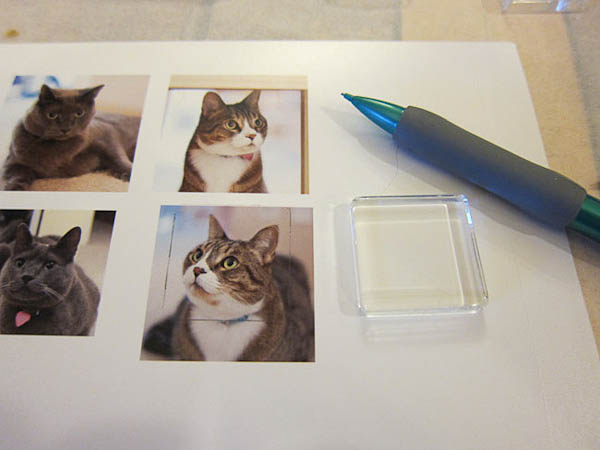
Trace the tile onto your photo.

Cut out the traced shape. I’ve seen people use an x-acto knife for this step which might work better for you. I’m a little terrified of knives because I’m extremely accident prone so I try to stay away from them.

Put a dab of Diamond Glaze on the glass piece and spread it across the entire tile with a toothpick.

Place the photo facedown onto the glaze. Press down to make sure all the air bubbles are out.

You can also flip it over and press down to make sure all the air bubbles are out. Wipe away any excess that leaks out.

Diamond Glaze is water soluble so you can clean up any messes with a damp towel.

Repeat for all your photos. Wait 10-15 minutes for the glaze to dry.

Flip the tile over and put another layer of Diamond Glaze on top of the photo. Spread the glaze out with a toothpick, sealing the photo in.

Wait another 10-15 minutes for the glaze to dry.

Put a dab of superglue onto the back and drop the magnet on.

And that’s it!

Once your glue is dry, you can put your photo magnets on the fridge.

You can use the same technique with other printed materials like stationary or a design you print out yourself. If you don’t want to purchase resin tiles, you can also use flat backed marbles that are found in most crafts stores.

Here are some other magnets I’ve made over the year. Anyone else out there a World of Warcraft fan? =D

Rubber Tubing Cover for Seam Rippers

So I am sporting a new war wound from the sewing trenches: I put a gash in my arm with my seam ripper. I have a bad habit of storing my seam rippers pointy side up in a basket, and this isn’t the first time that I’ve stabbed myself while reaching for something. I’ve decided it’s the last time though!

It’s bad enough that I keep cutting myself on the seam rippers, but my cats like to wander across my sewing table too and I’m worried that one of these days, they’ll poke out an eyeball or something. My cats are pretty clumsy for cats…

I know seam rippers come with a cover when you buy them, but I can never seem to hold on to mine. They always end up falling off and getting lost or misplaced.

I decided I could make a more secure solution using clear rubber tubing, so I headed off to Home Depot to check out the plumbing aisle. Yes, I actually took my seam ripper with me and tried shoving it into all the different size tubes to see what would work best. The Home Depot guys didn’t even blink an eye at me. =D

I decided on the 5/8″ wide tubing. Unfortunately Home Depot doesn’t sell tubing by the foot so I had to buy a coil of 10 ft. The total came out to a little over $5, which isn’t too bad.

When I got home, I put the seam ripper into the tubing again and marked the tube where I wanted to cut it.

I tried a couple different cutting techniques including using an x-acto knife and a regular pair of scissors. I got the best result using my rotary cutter. Use an old blade as cutting rubber obviously dulls the blade quickly.

And now my seam ripper has a cover!

If you have more than one seam ripper, check the measurement for each one individually. It turns out one of mine had a thinner handle and I had to cut a longer tube for it.

And then the seam rippers went into my basket, and now I won’t stab myself anymore!